Portugal: Portuguese Camino Coastal
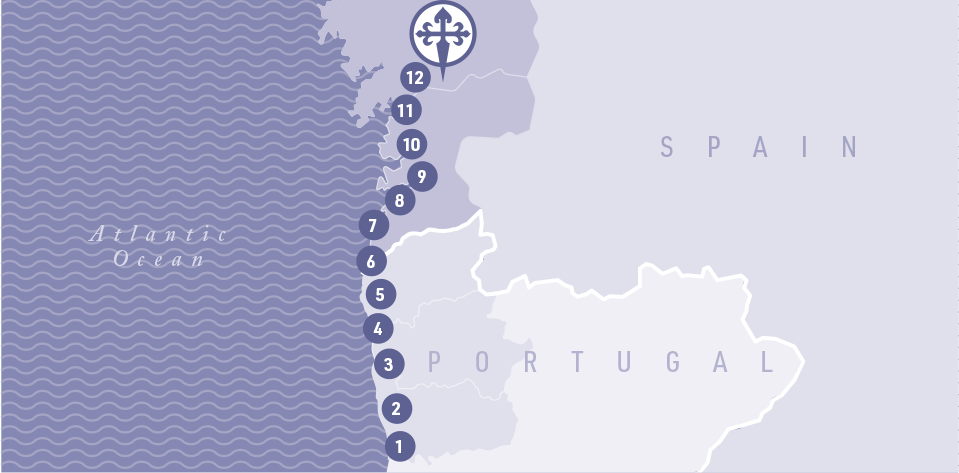
Camino Portugues: Coastal way from Porto to Santiago de Compostela
- Self-Guided Pilgrimage
- 13 nights hotel-to-hotel
- Moderate
- Flights available
- CO₂ rating 1/5
Trip highlights
Trip details
The Portuguese Coastal Way offers a tranquil route with magnificent coastal views to the city of Santiago de Compostela. Starting in the lively city of Porto, you’ll follow shells which mark the path, meandering through picturesque villages and along cobbled lanes, passing stone bridges, churches and quiet monasteries. The journey takes you through the ocean breezes of Portugal’s coast to the green hills of Galicia. Your final stop takes you to Santiago de Compostela, where you can appreciate this great city and its charming buildings.
What's included
Included
- 13 nights accommodation
- Official Pilgrim's Passport (Credencial)
- Comprehensive route directions
- Half-board except dinner in Porto, Vila do Conde, Viana, Vigo and Santiago
- Tourist taxes where applicable
Not included
- Flights
- All lunches
- 5 dinners in Porto, Vila do Conde, Viana, Vigo and Santiago
- Boat crossing of the Minho River, Day 6
- Drinks, personal expenses and visits to attractions
- Compostela Registration fees
- Compostela &/or Certificate of distance
- Entrance fees to sites
- Any local public transport or taxi fares, as per itinerary
- Luggage transport between accommodations
- Travel insurance
Travel options
- Flights
Our air prices include standard flights and transfers.
Itinerary
Day 1 · —Arrive into Porto

Arrive in Porto, taking time to explore its UNESCO listed historic centre, walk through the Cathedral district to the bustling Baixa Portuense. Stroll through Praca da Ribeira and ascend the Clerigos Tower for incredible panoramic views of the city. Visit the famous Lello Bookshop and cross the impressive Dom Luis I Bridge, designed by a student of Gustave Eiffel. Conclude your city walk at the riverfront and enjoy a drink of port wine from the region’s renowned wine cellars.
Day 2 · 22km/13.7miPorto to Vila do Conde

Leaving Porto behind you will make your way to Sao Bento train station where you will take the metro to Matosinhos, known for it’s lively fish market and the starting point of your pilgrimage. From this point you’ll follow the path marked by boardwalks along Portugal’s shoreline. You will pass vast sandy beaches, peaceful nature reserves and traditional fishing villages until you reach the historic coastal town of Vila do Conde.
Day 3 · 26km/16.2miVila do Conde to Esposende

You will start by passing through the neighbourhoods connecting Vila do Conde to the coastal town of Povoa de Varzim. Follow the coastline where you will walk amidst native flora and sandy beaches, where you’ll encounter the famous windmills of Apulia. From here, the route turns inland, leading through farmland, woodland and charming villages before crossing the wide Cavado estuary to arrive at the welcoming town of Esposende.
Day 4 · 27km/16.8miEsposende to Viana

Today’s stage begins once more along the wild and rugged coast before shifting inland through several quaint villages, peaceful forests and small river crossings. You’ll then cross the impressive Eiffel bridge, build in 1878, which spans the Lima River and leads to Viana do Castelo, a stunning city famed for its elegant architecture. From here you can enjoy sweeping views of the Lima Valley, its estuary and the distant mountain ranges beyond.
Day 5 · 19km/11.8miViana to Vila Praia

Before setting off, spend some time exploring the historic centre of Viana do Castelo. There is a funicular which offers a scenic ride to the Basilica of Santa Luzia, providing views over the city and Lima River estuary. From there, follow the coastal path, passing old windmills, rocky shores, golden beaches and rolling dunes. A wooden walkway guides you through the Caldeirao dunes to the Ancora River, which you follow and cross to reach the peaceful seaside town of Vila Praia de Ancora.
Day 6 · 28km/17.4miVila Praia to Oia

A flat coastal path connects Ancora to Moledo, before a quiet country road leads you to the charming town of Caminha. You’ll then cross the Minho River, Portugal’s natural border with Spain, by ferry (approx €10pp) or shuttle boat to reach the quiet fishing town of A Guarda, an ideal spot to enjoy fresh seafood. The path then continues through the town centre towards the coastline. The route will alternate between coastal paths, forest tracks and paved roads until you arrive at the small seaside village of Oia, crowned by its impressive 12-th century Cistercian monastery.
Day 7 · 19km/11.8miOia to Baiona

Today starts along the coast, passing through small fields, scattered houses and quaint villages. After 12km of walking, you can either continue along the coast, passing Cape Silleiro until you reach the beautiful Baiona, or you can take the marked inland route which offers different views, which includes a gentle climb toward the mountains. After crossing this small ridge, you will descend through peaceful countryside and rural villages leading you into the medieval centre of Baiona. One of Galicia’s most popular seaside towns, the city has fine sandy beaches and a charming historic centre.
Day 8 · 26km/16.2miBaiona to Vigo

One of the longer stages of the trip takes you through small seaside towns facing the Atlantic Island of Galicia National Park, home to the magnificent Cies Islands. Along the route, you’ll be presented with breathtaking views and vast sandy beaches, providing you with the perfect spot to rest and enjoy the ocean air. The day concludes in Vigo, a vibrant port city that combines it’s rich maritime heritage with the comfort and energy of a modern city.
Day 9 · 20km/12.4miVigo to Redondela

Leaving Vigo along its main shopping street, you’ll gradually depart the city on a long road that winds through calm hillside villages, offering lovely views of the city, the estuary and the port below. You will then ascend through wooded slopes with views of the Ria do Vigo before a sharp descent toward the charming town of Redondela. After passing through the town, you’ll leave the main trail and continue down to the seaside, where your accommodation awaits.
Day 10 · 18km/11.2miRedondela to Pontevedra

Your journey follows quiet country lanes, winding through serene forests and ancient Roman paths. Towards the end of the day you’ll arrive in Pontevedra, once one of Galicia’s most important ports. Take time to explore its beautifully preserved historic centre, home to two architectural wonders, the 16th century Basilica of Santa Maria and the 18th century Sanctuary of the Virgin of La Peregrina, a beloved symbol of pilgrimage.
Day 11 · 22km/13.7miPontevedra to Caldas de Reis
Today you’ll journey through vineyards and along ancient Roman roads. Midway, stop and explore the charming village of San Mauro before heading to the serene Agra River, guiding you to the elegant town of Caldas de Reis. This town was once an episcopal see until 569 and has, since the Middle Ages, welcomed countless pilgrims journeying north. Famed for its soothing thermal waters and natural hot springs, Caldas de Reis gives you the opportunity to unwind as you explore its deep Roman archaeological heritage.
Day 12 · 19km/11.8miCaldas de Reis to Padron
Your penultimate day begins with a gentle ascent through a number of quaint villages and the enchanting Valga Forest. Several striking churches and stone crosses line the way to Padron. Upon arrival, visit the Church of Santiago, home to El Pedron, the stone said to have been used to tie the boat that carried the body of the Apostle James from Jerusalem. It is said that Padron was the first location where St. James preached during his stay in Spain.
Day 13 · 25km/15.5miPadron to Santiago de Compostela
The final stage takes you through fragrant eucalyptus forests toward Santiago de Compostela. As you enter the famous city, take time to explore it’s historic streets, bustling squares and charming old quarters. Finally, you will reach the magnificent Cathedral of Santiago, the resting place of the relics of the Apostle James and the ultimate destination of your pilgrimage.
Day 14 · —Departure
Leave Santiago de Compostela and onward travels.
Enjoy exploring the town and consider an extra night before heading home.
What our travellers say
Independent service reviews collected by Feefo.
Positive impact
Carbon score for this trip
8.0
Kg CO₂e
per person, per night
Relative to other Headwater trips
We measure emissions from the parts of the holiday we organise — including accommodation, in-trip transport, meals and activities — and express them as CO₂e per person, per night. Our label doesn’t include your travel to and from the start of the trip. As a Certified B Corp, Headwater is committed to reducing this figure and to positively impacting local communities, the local environment and our staff. Learn more
Frequently asked questions
When is the best time of the year to walk the Portuguese Camino?
The best months are spring (April to June) and autumn (September to October), when temperatures are pleasant and the countryside is at its most beautiful. Summer is possible but can be hot.
Do I need a pilgrim Camino passport?
Yes, if you’d like to collect stamps along the way and receive the official Compostela certificate in Santiago. The pilgrim passport, or credencial, is a wonderful keepsake of your journey, it’s stamped at churches, cafés, and hotels as you progress. Even if you’re not walking for religious reasons, it adds a lovely sense of occasion and helps you access pilgrim menus and accommodation.
What type of Portuguese Camino accommodation is provided?
On our Portuguese Camino holidays, you’ll stay in hand-picked hotels and guesthouses that combine comfort with authentic local character. Each property offers a warm welcome, en-suite facilities, and a relaxing atmosphere – the perfect place to unwind after a day’s walk.
What is the Portuguese Camino Coastal Way?
The Coastal Way is a scenic alternative to the traditional inland Portuguese Camino route. Starting in Porto, it follows the stunning Atlantic coastline through charming fishing villages and sandy beaches before joining the main Camino in Redondela. It’s ideal for walkers who love sea views and a gentler pace.
Do I need to be religious to join a pilgrimage walk?
Not at all. While the Camino has deep spiritual roots, many people walk for cultural, historical, or personal reasons. Whether you’re seeking reflection, adventure, or simply a beautiful walking holiday, the Camino welcomes everyone.
Is there any luggage restriction on Camino Portuguese Coastal?
If you have luggage transfers booked, the service is limited to one item per person. Please restrict the weight of each piece of
luggage to no more than 20kg. There may be an additional charges should you bring more luggage, please advise us prior
to departure so any extra luggage services can be arranged.
At your first hotel, please mark your bags with the Surname of the lead booker and number each bag (1 of 2, 2 of 2
etc.). Please also ensure that where possible you lock your bags and leave nothing valuable in them. Please note we cannot
be held responsible for any damage.
Please have your bags ready for collection by 8am. We make every effort to deliver your luggage to the next hotel by 6pm,
please contact us locally if your luggage has not arrived by this time.
How long is the Portuguese Camino Coastal route?
The full Coastal Way from Porto to Santiago de Compostela is around 280 km, typically walked over 12 days.
What is the recommended Portuguese Camino coastal packing list?
We suggest packing:
Comfortable walking shoes or boots (well broken-in)
Lightweight, breathable clothing and layers
Waterproof jacket and a small daypack
Reusable water bottle
Sun protection (hat, sunglasses, sunscreen)
Repelent for ticks and insects
What Portuguese Camino meals are provided?
Breakfast is included each morning, and you’ll find plenty of local cafés and restaurants along the route for lunch and dinner. Expect delicious Portuguese and Galician dishes, fresh seafood, grilled meats, hearty soups, and the famous pastel de nata for dessert. Pair it with a glass of vinho verde or local wine for the perfect end to your day.