Japan: Pilgrimage Kumano Kodo
Pilgrimage: The Kumano Kodo Nakahechi Pilgrimage Path – Takijiri to Mount Nachi
- Self-Guided Pilgrimage
- 5 nights hotel-to-hotel
- Demanding
- Flights available
- CO₂ rating 1/5
Trip highlights
Trip details
The Kii Peninsula stretches south from Kyoto and Osaka, offering one of Japan’s most remote and mystical landscapes, a striking contrast to the bustle of the nearby cities. For over a thousand years, this sacred region has been a revered destination for spiritual seekers and emperors alike.
What's included
Included
- 5 nights accommodation
- All breakfasts and 5 evening meals
- Accommodation in hotels and Japanese-style inns (ryokan, minshuku). Japanese-style accommodation will generally be in tatami-mat rooms
- Individual train tickets from Kyoto or Osaka to the Kumano Kodo trail and from the Kumano Kodo trail to Kyoto or Osaka
- A pre-booked and pre-paid taxi to Koguchi on Day 5
- Detailed day-to-day printed itinerary and walking directions along with Topographical maps on arrival
Not included
- Flights
- Local taxes/fees
- Lunches, drinks with meals, snacks and miscellaneous items of personal expenditure
- Entrance fees to museums, temples etc.
- Local transportation not mentioned in 'What's Included' section
- Luggage transfer - Service available, payable locally
- Travel Insurance
- Travel insurance
Travel options
- Flights
Our air prices include standard flights and transfers.
Itinerary
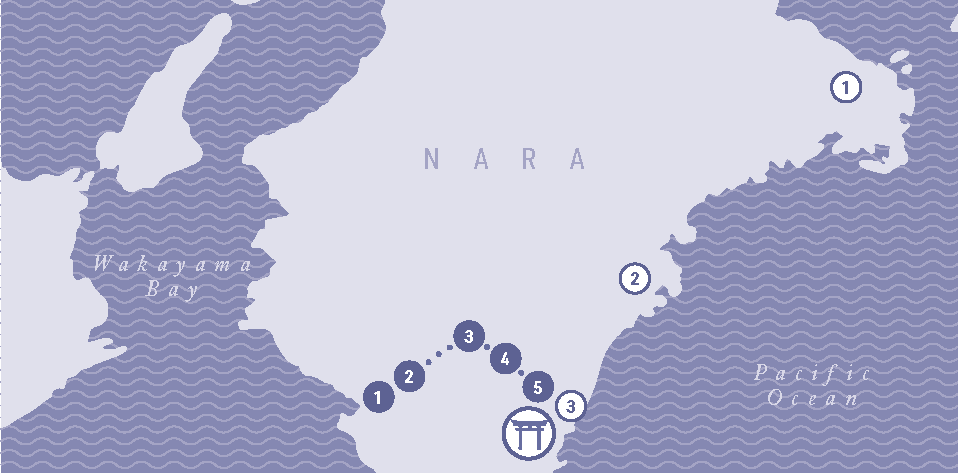
Day 1 · 5km/3.1miTakijiri to Takahara

Your tour begins in either Osaka or Kyoto, where you will take a scenic train journey to Kii-Tanabe. Part of the route traces the spectacular coastline of the Kii Peninsula, offering stunning sea views along the way. On arrival in Kii-Tanabe, a bus ride will bring you to the starting point of today’s walk on the Nakahechi trail, a historic section of the revered Kumano Kodo pilgrimage route. From Takijiri, the trail ascends steadily through forested hills to the ridge top village of Takahara. Tonight, your stay will be in either Takahara or the nearby village of Karisugawa, where you will experience authentic local hospitality and a serene countryside atmosphere.
Please consider adding a night before the start of the trail to best prepare for your trip and allow for your documentation to be delivered to you.
Day 2 · 10km/6.2miTakahara to Chikatsuyu

Fuel up with a tasty Japanese breakfast before setting off on the trail to Chikatsuyu. You will pass through small villages and by several Oji shrines, before finally descending to your destination for the night. The path is clear and well marked, with stone flagging laid along steeper sections to make the climbs easier. You will spend the night in Chikatsuyu or Nonaka, at a local minshuku.
Day 3 · 24km/14.9miChikatsuyu to Hongu

Begin your day with an early start as you set out from Chikatsuyu, following the sacred Kumano Kodo pilgrimage trail through the serene mountains of Hongu. The route winds through peaceful forests and mountain villages, offering glimpses of traditional rural Japan. Your journey leads you to Kumano Hongu Taisha, one of the Three Grand Shrines of Kumano and a deeply spiritual site in Japanese Shinto tradition. According to ancient mythology, the heart of these mountains was believed to be the entrance to Yomi, the ‘other world’ through which spirits would travel after death. After this immersive walk, a short bus ride will bring you to Yunomine Onsen, one of Japan’s oldest and most atmospheric natural hot spring villages.
Day 4 · 12km/7.5miOptional Hike along the Nakahechi Trail

Start the day by exploring the tranquil village of Hongu, soaking up its atmosphere and traditional charm. From here, you can choose between two rewarding Kumano Kodo hiking routes. The first option is to ascend the Kogumotorigoe path towards Koguchi. This journey begins with a short bus ride to Ukegawa, the starting point of the Kogumotorigoe Pass trail. The route leads you through lush forests and scenic mountain paths before descending into the quiet village of Koguchi. Alternatively, you may opt to hike another section of the trail near Hongu, offering views across the surrounding valleys and countryside. For those seeking a gentler pace, you can spend the day relaxing in one of the nearby hot spring villages, enjoying the healing waters that have soothed pilgrims for centuries.
Day 5 · 15km/9.3miKoguchi to Nachi-san

The final section of your Kumano Kodo pilgrimage leads you from Koguchi up the Ogumotorigoe Pass, one of the most scenic and historic parts of the trail. After a steady climb through ancient cedar forests, the path descends towards Nachi-san, where you’ll discover Kumano Nachi Taisha, one of the Three Grand Shrines of Kumano. Here, the sacred Nachi Taki Waterfall cascades dramatically beside the shrine, Japan’s tallest single drop waterfall and a symbol of spiritual purity. Following, bus ride will take you to the port town of Kii-Katsuura, where you can enjoy panoramic views of the bay.
Day 6 · —Kii-Katsuura and onwards by train to Osaka or Kyoto

Kii-Katsuura is an active fishing port and one the main attractions is their fishing market and the islands that dot the bay. It is also possible to visit Hayatama Shrine in Shingu one of the three grand shrines of Kumano. Board your train back to Kyoto ot Osaka around lunchtime to reach either city mid or late afternoon. To make the most of your experience, consider adding an extra night in either city to further explore their vibrant culture, historic sites, and local cuisine at a more relaxed pace.
What our travellers say
Independent service reviews collected by Feefo.
Positive impact
Carbon score for this trip
26.0
Kg CO₂e
per person, per night
Relative to other Headwater trips
We measure emissions from the parts of the holiday we organise — including accommodation, in-trip transport, meals and activities — and express them as CO₂e per person, per night. Our label doesn’t include your travel to and from the start of the trip. As a Certified B Corp, Headwater is committed to reducing this figure and to positively impacting local communities, the local environment and our staff. Learn more
Frequently asked questions
How long does it take to walk the Kumano Kodo?
The Kumano Kodo is a network of pilgrimage trails, so the duration depends on your chosen route. Our itineraries typically range from 4 to 6 walking days, covering sections of the Nakahechi route – the most popular and historically significant trail – or the Iseji path. This allows time to enjoy the landscapes, shrines, and cultural highlights at a comfortable pace.
When is the best time to walk the Kumano Kodo?
The best seasons are spring (March to May) and autumn (September to November), when temperatures are mild and the scenery is spectacular. Spring brings cherry blossoms, while autumn offers vibrant foliage. Summer can be hot and humid, as well as the busiest time to visit Japan.
How does luggage transfer work for the Kumano Kodo pilgrimage trail?
For the Nakaechi trail, we would recommend sending main luggage from the accommodation before the trail to Yuinomine/Kawayu Onsen (Day 3), and then from there to wherever clients stay after the trail.
For the Iseji trail, we would suggest to send the main luggage from their accommodation before the trail to Kumano City (Day 3), and then from here to wherever they stay after the trail.
This can be done using the Takkyuibin service, read more about it on our Pilgrimages FAQs.
What is the recommended Kumano Kodo packing list?
We recommend packing:
Comfortable walking shoes or boots (well broken-in),
Lightweight, breathable layers for changing weather,
Waterproof jacket and a small daypack,
Reusable water bottle,
Sun protection (hat, sunglasses, sunscreen),
Spray repellent for ticks and insects,